Forward Leaning Inversion: How It Works, and How to Do It Safely
If you've spent any time researching natural ways to encourage optimal fetal positioning, you've probably heard of the Forward Leaning Inversion.
This movement is one of the most well-known techniques from Spinning Babies® and is commonly used by families hoping to encourage better fetal positioning, improve comfort in pregnancy, and sometimes help a breech baby find the space needed to turn head down.
At The Breezy Doula, this is one of the most frequently recommended Spinning Babies® activities because it is simple, and often helps create more balance within the pregnant body.
What Is a Forward Leaning Inversion?
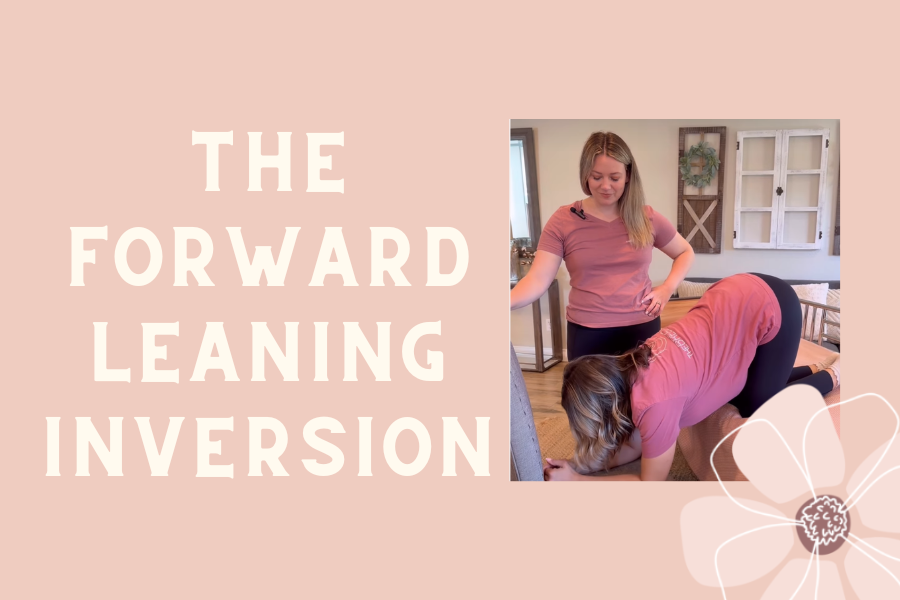
The Forward Leaning Inversion is a position where the birthing parent kneels on an elevated surface, such as a couch or sturdy bed, and carefully lowers their hands to the floor below. For a short period of time, the hips are positioned higher than the head. While it may look like a movement designed to "flip" a baby, that is actually not its primary purpose.
Instead, the goal is to temporarily take pressure off the lower uterine segment and supporting ligaments so they can reset and rebalance. Those ligaments tpically twist and turn the uterus as you move about your day, causing the cervix to be misaligned and hold tension.
Why Does the Forward Leaning Inversion Work?
Spinning Babies® is based on a simple philosophy: Balance first. Gravity second. Movement third.
When muscles, ligaments, and soft tissues become tight or uneven, they can influence how a baby settles into the pelvis.
The Forward Leaning Inversion works by:
Releasing tension in the lower uterine ligaments
Creating more balance in the pelvis
Reducing asymmetries in the uterus
Giving baby more room to reposition
Encouraging optimal fetal positioning
Many families assume that baby positioning is only about the baby's choices. In reality, babies often respond to the space available to them. When the body becomes more balanced, babies frequently have an easier time finding an ideal position for birth.
What Can the Forward Leaning Inversion Help With?
Many families use this technique to help with:
Breech positioning
Posterior babies (sunny side up)
Asynclitic positioning
Pelvic discomfort
Back pain during pregnancy
Creating more comfort during labor
Encouraging baby to engage in the pelvis
While no technique can guarantee a baby will turn or move into a specific position, many families find it to be a valuable part of their pregnancy routine.
How to Perform a Forward Leaning Inversion
Before attempting this movement, make sure you have a support person nearby if possible. This can cause dizziness or nausea which can be dangerous if you are on an elevated surface without support.
Do not do this movement if you have the following: High blood pressure, preeclampsia, history of aneurisms or risk of stroke, cardiac issues, pregnancy complications or other medical conditions or discomforts. Consult your healthcare provider first.
Step 1
Kneel near the edge of a couch, sturdy bed or elevated surface.
Your knees should remain securely supported. If you are on a soft surface, you can use a cutting board to support you underneath your knees.
Step 2
Slowly lower your hands to the floor.
Continue lowering until your forearms or hands are resting comfortably on the ground.
Your head should be lower than your hips.
Step 3
Relax your neck and shoulders. Tuck your chin.
Take slow breaths.
Hold the position for approximately 30 seconds or 3 breaths.
Step 4
To come out of the position, carefully return to the elevated surface one arm at a time.
Move slowly and avoid sudden movements.
Step 5
Once upright, rise all the way up off your legs and remain in this position for 2 minutes to allow your uterus to settle back into place. This step is very important for alignment so don’t skip it. Once finished, ‘mermaid out’ of that position.
How Often Should You Do It?
For general pregnancy wellness and balance: One Forward Leaning Inversion per day is commonly recommended starting after 20 weeks of pregnancy.
For a breech baby:
Spinning Babies® often recommends performing the Forward Leaning Inversion seven times in 24 hours for one week, along with other balancing activities and professional support.
The goal is not to force the baby to turn. The goal is to repeatedly create opportunities for the baby to find more space.
What If My Baby Doesn't Turn?
This is important:
Not every breech baby will turn.
Sometimes there are reasons a baby remains breech, including:
Umbilical cord positioning
Placental location
Uterine shape
Amount of amniotic fluid
Baby's unique anatomy
A breech baby is not a sign that you did something wrong. The purpose of these techniques is to encourage balance and create opportunity, not guarantee a specific outcome.
Other Ways to Encourage a Breech Baby to Turn
The Forward Leaning Inversion is often most effective when combined with other supportive approaches such as:
Spinning Babies® balancing activities
Webster-certified chiropractic care
Acupuncture
Moxibustion
Hypnosis and fear-release techniques
Walking and movement
External Cephalic Version (ECV) when appropriate
Every family is different, which is why personalized support can be so valuable.
Why We Love Teaching Spinning Babies®
At The Breezy Doula, we teach Spinning Babies® because it helps families understand why positioning matters.
Our classes cover:
Daily activities that promote balance in pregnancy
The Three Balances philosophy
Birth positions and how they affect the pelvis
Techniques to encourage optimal fetal positioning
Ways to create more space for baby during pregnancy and labor
Rather than focusing on forcing a baby into a certain position, we focus on helping the body become balanced and efficient. When balance, gravity, and movement work together, babies often find the space they need to move and rotate on their own.
The Forward Leaning Inversion is one of the simplest and most effective Spinning Babies® techniques for creating balance in pregnancy. It works by helping release tension in the supporting structures of the uterus and pelvis, creating more room for baby to find an optimal position.
Whether you're hoping to encourage a breech baby to turn, improve comfort during pregnancy, or prepare your body for labor, the Forward Leaning Inversion can be a valuable addition to your daily routine.
As always, discuss any new exercise or positioning technique with your healthcare provider, especially if you have a high-risk pregnancy or medical complications.
And remember: the goal is not perfection. The goal is creating balance, supporting your body, and giving your baby the best opportunity to find their way.